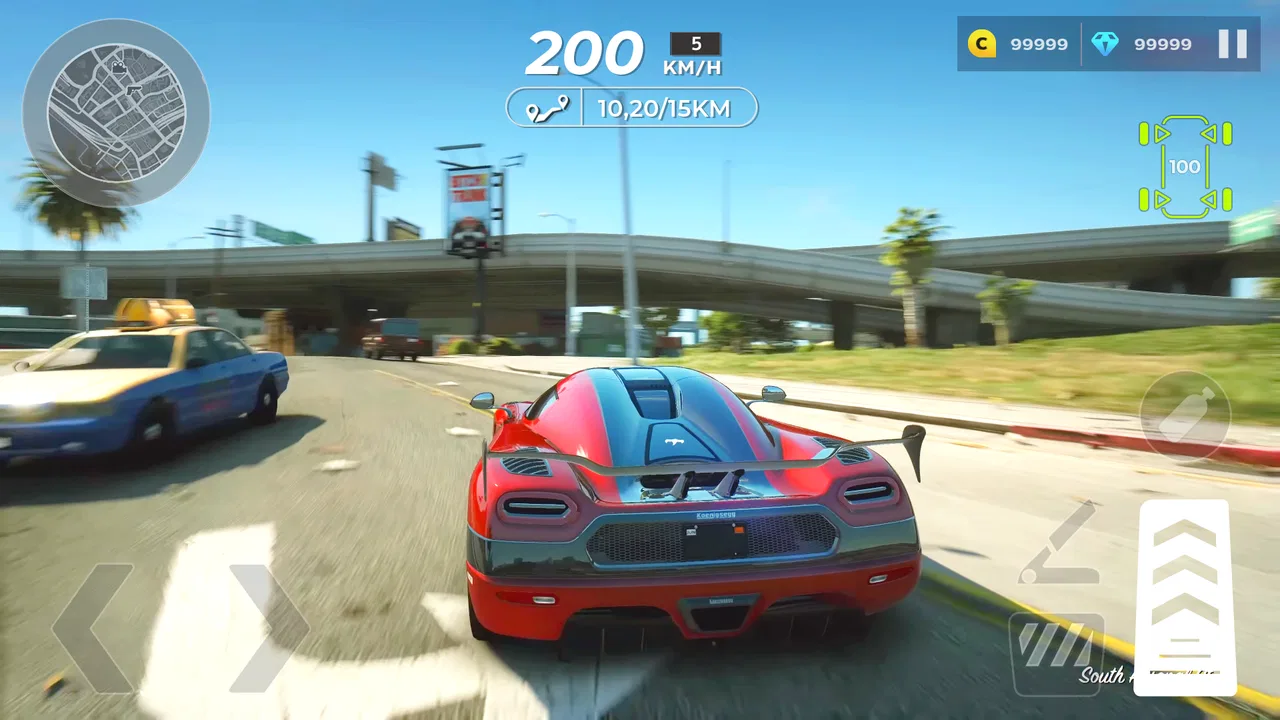
Car Driving: Drag Racing 3D
- 4.8
- Rating
- 10.00M
- Installs
- Free
- Price

 Analysis by App-foxy
I spent time with Car Driving: Drag Racing 3D as a casual driving game and came away with a fairly clear impression: it is aimed at people who enjoy adjusting a car, trying a run, and chasing a cleaner result without committing to a large racing game. Its focus is simulation-flavored rather than story-driven, and the appeal comes from the relationship between setup and driving. You are not simply choosing a vehicle and watching numbers rise; the interesting question is whether your changes actually make the car feel more manageable on the next attempt.
That makes it easy to pick up for a short session. I can imagine opening it while waiting for an appointment, making a small adjustment, running a few races, and putting it away without needing to remember a complicated campaign. At the same time, this is not the right choice for everyone. Players who want a deep career, a large open world, licensed cars, or a highly detailed competitive ecosystem may find the experience narrower than expected. The game works best when treated as a compact tuning-and-driving pastime.
What the game is really about
SpeedZone is the developer behind this free simulation game, which carries an Everyone age rating. It has reached over a million installs and holds a 4.8 average from around 5,100 ratings, so it has clearly attracted a substantial audience for a focused mobile driving experience. The current version is 1.4.3, and it runs on Android 7.1 or later. Those details make it accessible to people using older compatible devices, although actual comfort will still depend on the phone's screen, controls, and performance.
You May Also Like

 Blood Strike: 2.5 Anniversary
Blood Strike’s Loadouts Turn Every Drop Into a Tactical Gamble
A close look at Blood Strike’s custom loadouts: how fast access to signature weapons reshapes its battle royale rhythm, rewards preparation, and narrows the gap between fights.

 Pandora - Music & Podcasts
Pandora’s Music Is Easy to Start, but Harder to Recover
Pandora’s strength is its low-effort path from a seed to a station. Its weak spot is how much confidence it asks you to place in connection, setup, and quiet recovery.

 8 Ball Pool
 Is Built on Rivalries, Rematches, and Routine
A close look at the rivalries, rematches, shared routines, and unanswered safety questions that turn a quick pool match into a persistent mobile community.

 Samsung Music
’s Quiet Strength Is Playing What You Already Own
Its reach comes less from spectacle than from dependable access to a personal library. That simplicity is both the app’s strongest retention engine and its ceiling.

 AccuWeather: Weather Radar
AccuWeather Review: A Quick, Clear Forecast for Everyday Decisions
For everyday plans, the best forecast is the one you can understand quickly. AccuWeather makes rain timing, radar, and local conditions easy to act on, with a few trade-offs.

 Hill Climb Racing
Why Hill Climb Racing Still Turns Crashes Into One More Run
A tiny car, a bumpy hill and one more upgrade: Hill Climb Racing keeps resurfacing because its simple chaos makes every near-miss feel personal.
More From Our News Desk
View All News


The basic idea is simple: customize and tune cars, then use them in drift-oriented racing. I like that the central loop is understandable immediately. There is no need to learn an elaborate set of menus before discovering what makes the game enjoyable. You can approach it as a driving toy, a tuning exercise, or a way to practice finding a setup that suits your style.
Its store short description is simply “Car Driving,” but that undersells the more specific character of the experience. The important distinction is that the car is not just decoration. The tuning angle gives each run a purpose, even when the session is brief. A good attempt is not only about finishing; it is about noticing whether the car responds more predictably after your changes.
The strongest reason to try it is the short feedback loop between adjustment and driving. That loop is more satisfying than a conventional arcade racer when you enjoy experimenting. Instead of treating every loss as a reason to grind, I found it more useful to ask what the car was doing: was it too difficult to control, too eager to slide, or simply not matching the way I was driving?
Getting comfortable with the driving
The first sessions are best used for learning the game's feel rather than immediately chasing the best possible result. Mobile driving controls can be sensitive, and drifting asks for a different rhythm from ordinary steering. I recommend beginning with small movements and paying attention to how quickly the car reacts. Overcorrecting is an easy way to turn a promising run into a messy one.
One practical habit helped me: change one part of the setup at a time whenever possible. If you alter several things together and the next run feels better, you will not know which change mattered. A single adjustment creates a clearer comparison. This is especially useful in a game built around tuning, because the satisfaction comes from understanding the car rather than randomly searching for a winning combination.
I also found that short test runs are more valuable than long, unfocused sessions. After a few attempts, it is tempting to keep repeating the same mistake because the next run feels as if it must be the one that works. Taking a moment to identify the problem gives the next attempt a purpose. That approach makes the game feel more like a small driving laboratory than a button-mashing race.
Players who are new to drift games should expect a learning period. The car may not behave exactly as a normal road vehicle would, and success depends on timing as much as direction. If you prefer instant, forgiving arcade handling, this may feel demanding at first. If you enjoy gradually building control, the same friction becomes part of the appeal.
Progress without turning every session into a chore
The game's compact structure suits players who want progress in manageable pieces. I would use it differently depending on the length of the available session. With only a few minutes, I would focus on one tuning question. With more time, I would compare several setups and repeat a route or event to see whether the improvement was consistent rather than accidental.
That distinction matters because racing games can create pressure to keep playing after a disappointing result. Here, the danger is not necessarily a huge time commitment; it is the urge to keep making changes without learning from them. A disciplined routine makes the experience more enjoyable: establish a baseline, test a modification, and keep the change only if it improves control or results in a way you can reproduce.
For an everyday scenario, imagine a player using an older Android phone during a commute break. They do not want to download a large, story-heavy title or spend half an hour setting up a multiplayer match. They can open this game, run a few attempts, and use the tuning system as a small mental reset. That is where its free entry point and focused design are most attractive.
On the other hand, a player who needs a strong long-term progression structure may eventually want more variety than this format provides. A game built around driving and tuning can remain engaging for a while, but its longevity depends heavily on how much pleasure you get from refining technique. If you need constant new events, narrative rewards, or a large collection of activities, a broader racing game would probably be a better fit.
Spending, access, and what can be judged fairly
The game is free to download, which removes the main barrier to trying it. That is useful because the handling style is personal: some players will enjoy the drift-focused loop immediately, while others will prefer a more forgiving or more expansive racer. Installing it lets you make that decision through actual play rather than relying on screenshots or a short description.
I am careful not to treat “free” as proof that the entire experience is automatically fair. A free game can still create pressure through progression, repeated attempts, or optional spending, and those details affect how comfortable it feels over time. In this case, I would judge the game by how clearly it lets you understand what you are doing and whether tuning feels meaningful rather than merely decorative.
There is no reason to assume that spending is necessary simply because the game is free. Equally, I would not promise that every part of progression is unaffected by optional purchases without seeing the exact purchase flow in the version you use. My practical advice is straightforward: try the driving first, and do not spend just to solve a frustrating run. If a car feels difficult, test your technique and one setup change before treating payment as the answer.
This is also where the game differs from a premium racing title. A paid alternative may offer a clearer upfront bargain and a more controlled progression model, while a free game gives you a lower-risk trial. The better choice depends on whether you value immediate access or a more predictable purchase experience. For a casual player, free access is a real advantage; for someone sensitive to in-game pressure, the surrounding purchase design deserves attention before committing time or money.
Fair competition and the limits of comparison
When I compare this game with usual alternatives, I would place it closer to a focused mobile drift simulator than to a full racing platform. Traditional arcade racers generally emphasize speed, spectacle, and easy-to-understand action. This title is more interesting when you want the car's behavior and setup to matter. A large driving simulator may offer more environments and activities, but it can also demand more storage, more time, and more attention than a short-session player wants to give.
The question of competitive fairness depends on what kind of competition you expect. If your goal is personal improvement, the tuning loop gives you a useful way to measure progress: can you make the car easier to control, and can you repeat a good run? If you are looking for a carefully balanced online leaderboard or an esports-style environment, you should be more cautious. The game's appeal does not automatically establish that every vehicle, setup, or player has identical competitive conditions.
I prefer to approach it as a personal performance challenge unless the game itself makes competitive rules especially clear. That keeps the experience honest. You can still compare your own attempts and develop better control, but you are not relying on assumptions about matchmaking, vehicle balance, or purchase advantages.
A useful advanced habit is to separate driver improvement from car improvement. Run a familiar setup until your steering becomes consistent, then change the car. If your result improves after both changes, you will have a better idea of what actually helped. This prevents the common mistake of blaming the vehicle for errors that come from timing, or blaming your technique when the setup is simply uncomfortable.
Who should play it, and who should skip it
I would recommend it to someone who likes cars but does not necessarily want a full-scale racing commitment. It is particularly suitable for players who enjoy making small adjustments, repeating a challenge to improve, and learning through trial and error. The Everyone rating also makes it approachable for a broad audience, although younger players should still have a parent or guardian handle any spending decisions on the device.
It is also a sensible option for owners of older compatible Android hardware who want a driving game without immediately moving to a demanding modern release. The minimum operating system is Android 7.1, which gives it a wide compatibility range. Compatibility alone does not guarantee perfect performance on every phone, so I would still begin with a short test session and check whether the controls feel responsive.
I would skip it if your priority is a realistic driving school, a detailed open-world map, or a rich narrative career. I would also look elsewhere if you dislike repeating runs. Tuning games ask you to revisit the same kind of challenge with a different mindset. If repetition feels like wasted time rather than practice, the core loop may become tedious.
Players who want a guaranteed, transparent premium experience may also prefer a paid alternative. The free model is convenient, but the value question is not only about the download cost. It is about whether the game respects your time and gives you enough meaningful control to justify continued attention. That is something I would evaluate personally before making any purchase.
Small details that improve the experience
My first tip is to keep a mental record of what changed between attempts. You do not need a formal spreadsheet; simply remember whether the last adjustment made the car calmer, more responsive, or harder to hold. This turns random experimentation into a repeatable process and makes the tuning feature feel deeper.
My second tip is to avoid chasing a dramatic drift immediately. A controlled, modest slide teaches you more than a spectacular mistake. Once you understand how the car begins to rotate and how quickly it responds to correction, you can push harder with a better chance of recovering. This is especially helpful on a touchscreen, where tiny input differences can have a large effect.
My third tip is to use the game as a comparison tool rather than assuming one setup is universally best. A setup that feels comfortable for a careful driver may feel slow or dull to someone who prefers aggressive movement. The right question is not “What is the best car?” but “Which car and setup let me drive consistently?” That is a more useful standard for a game centered on personal control.
Finally, take breaks after several failed attempts. Fatigue makes touchscreen corrections less precise, and it can make the game seem less fair than it is. Returning later with a clear head often tells you whether the problem was the setup, the controls, or simply impatience. That is a small but important difference between constructive practice and frustrating repetition.
My trust verdict after using it
Car Driving: Drag Racing 3D is a focused free driving game with a clear identity: adjust cars, learn their behavior, and improve your runs. SpeedZone has kept the concept approachable enough for short sessions while giving car-focused players a reason to experiment. Its strong user response and broad install base make it an easy title to consider, but those figures should not replace your own judgment about handling and progression.
I would start with it if I wanted a low-risk way to explore drift racing on Android, especially on a compatible older device. I would keep expectations realistic about scope, and I would treat competitive claims and spending decisions carefully rather than assuming that every part of the experience is equally transparent. My recommendation is to try the free version for the driving itself, spend only when the value is clear, and move to a broader or premium racer if you need more than tuning and repeated improvement.
In the end, the game succeeds when you enjoy the process of making a car feel better under your hands. It is less convincing as an all-purpose racing replacement, but that is not a weakness if you want a compact simulator with a drift-first personality. For the right player, a few thoughtful setup changes can make a short session feel surprisingly rewarding.
FAQs for Car Driving: Drag Racing 3D
01What are the main features of Car Driving: Drag Racing 3D?
Car Driving: Drag Racing 3D offers a thrilling racing experience with realistic physics, customizable cars, and various racing modes. Players can engage in head-to-head drag races, upgrade their vehicles for better performance, and compete in global leaderboards. The game also features stunning 3D graphics and intuitive controls that enhance the overall gameplay experience.
02Is Car Driving: Drag Racing 3D free to play?
Yes, Car Driving: Drag Racing 3D is free to download and play. However, it includes in-app purchases that allow players to acquire additional features, vehicles, and customization options. These purchases are optional, and players can still enjoy the game's core features without spending money.
03What devices are compatible with Car Driving: Drag Racing 3D?
Car Driving: Drag Racing 3D is available for both Android and iOS devices. It requires Android version 5.0 or higher and iOS version 10.0 or later. Ensure your device meets these requirements for optimal performance, as older devices may experience lag or compatibility issues.
04Does Car Driving: Drag Racing 3D require an internet connection?
While Car Driving: Drag Racing 3D can be played offline, certain features like multiplayer racing, leaderboards, and in-app purchases require an internet connection. Playing online enhances the experience by allowing you to compete with players worldwide and access the latest updates and events.
05How can I improve my performance in Car Driving: Drag Racing 3D?
To excel in Car Driving: Drag Racing 3D, focus on upgrading your car's engine, tires, and aerodynamics for better speed and handling. Mastering the timing of gear shifts is crucial for winning races. Additionally, participating in events and challenges can earn you rewards and help you practice your skills against different opponents.
Pros
- Realistic physics enhance gameplay experience.
- Wide range of customizable cars available.
- Stunning graphics for a mobile game.
- Offers various challenging race tracks.
- Intuitive controls make it easy to play.
Cons
- In-app purchases can be quite expensive.
- Occasional ads disrupt gameplay.
- Limited offline gameplay options.
- Can be demanding on older devices.
- Progression may feel slow without spending.

Car Driving: Drag Racing 3D
Gallery